Girl wake up, Google just rolled out three major new travel features today. And I don't want you to just scroll past the announcement.
Because they're real game changers (especially for points-and-miles travelers reading this).
Here's what makes this different from every other “here's what's new” post in your feed: I helped build it.
Kind of. Back in April of this year, Google flew me and 25 travel creators to New York for private product orientation and feedback sessions with the Search team. We gave expert feedback on the exact features launching today, workshopped in a room I sat in.
Real feedback, from the people who live the problem, handed straight to the team building the fix. That's pretty cool.
60+ countries traveled, and 6 years as a travel expert and full-time travel creator.
That's the lens I'm reading this launch through, and it's the lens I'm handing you.

So what's new? Google announces three separate travel features: tracking flight fare, redeeming points, and direct hotel booking — now live inside one free AI Mode conversation, starting today.
1. Flight price tracking: track flight prices without leaving the chat
Planning a trip used to take several months and hundreds of search queries. Flights, hotels, translations, reservations, all split across different tabs and different apps…
That's the whole reason today's update exists.
Via their Google Flights tool, they've helped travelers track a route and get emailed when prices move for years. But it was tucked behind a “Track prices” toggle inside a separate app that is easy to miss.
Today, that same tracking moves into AI Mode itself.
Users can describe where and when they want to fly, and AI Mode pulls live pricing from more than 300 partner airlines and travel sites to show you the best options.
If you want to wait it out, just say something like “track these flight prices for me,” confirm, and you'll get an email the moment prices shift.
Is it reliable?
This is where the reliability question matters most, since flight prices change by the hour.
The reassuring part is the architecture: AI Mode is pulling live numbers from 300+ real partners rather than estimating. I asked them about this question specifically, and the Google Search team noted that the AI should respond with qualifiers on its level of certainty, using phrases such as “as of 5 minutes ago,” “as of now,” or “you should check the website to confirm.”
Google just made it reachable from a simple request instead of a manual settings toggle.
Flight price tracking in AI Mode is live now in more than 180 countries and territories, with the EEA excluded for now, per Google's rollout notes.
Steal these travel prompt ideas:
AI can be overwhelming, and just because a new feature is introduced doesn't mean we all know how to use it best.
So for each new feature, I'm dropping 5 practice prompts for you to steal and test in Google AI yourself to get the hang of using them.
Here are some ways you can practice prompting for flight price tracking:
- “Alert me via email the second a flight to Cancún for two adults drops under $200 round-trip.”
- “Track flights from Chicago to Lisbon for two people in June and let me know if the price moves.”
- “I'm flexible on dates, track the cheapest week to fly from LA to Seoul this fall.”
- “Watch this exact nonstop flight to Nairobi and tell me if it drops before my trip in December.”
- “Track prices on a one-way flight from Houston to Medellín for a solo trip in January.”
2. Points & miles: see the real cost of a flight or hotel in points or miles, not just cash
This is the new feature the creators were most excited about, and I think travelers will feel first:
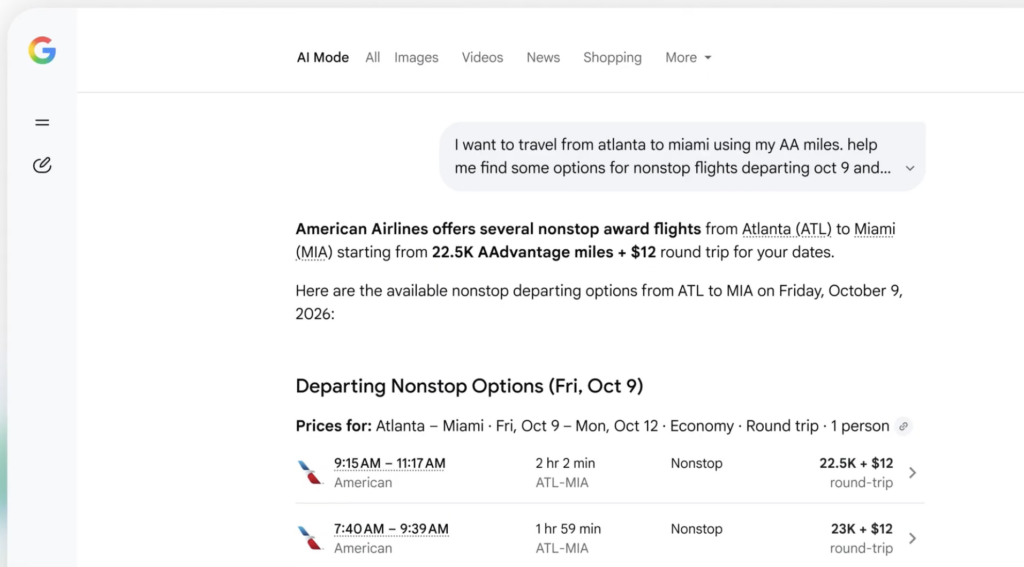
Ask AI Mode something like “I want to travel from New York to Tokyo using my United miles, find nonstop flights departing October 9th, returning October 12th, and show me how many miles versus cash,” and it pulls the points cost straight from partner data, right next to the cash price.
It works the same way for hotels: describe your trip and the rewards program you're redeeming through, and AI Mode shows you the points cost for that stay too.
That's insane.
This launches globally today with Alaska Airlines and Hawaiian Airlines, American Airlines, Choice Hotels, Hilton, and Wyndham live at launch. Accor, Flying Blue, Hyatt, LATAM Airlines, and Lufthansa Group are all coming in the next few weeks.
Steal these travel prompt ideas:
- “Show me a Marriott Hotel stay in Nashville in points instead of cash for a long weekend.”
- “How many IHG points do I need for a week in New Orleans, and is that a better deal than paying cash?”
- “Compare paying cash versus Delta miles for a flight from Seattle to Atlanta next month.”
- “Show me this 3-night Hilton stay in October in points versus cash.”
- “I have Air France-KLM miles, find me the best redemption for a trip to Lisbon in the spring.”
3. Hotel Search: book your hotel (direct), without leaving the conversation
We used to have to search for hotel deals, maybe in Google Maps, and scroll through different prices and manually play with the dates.
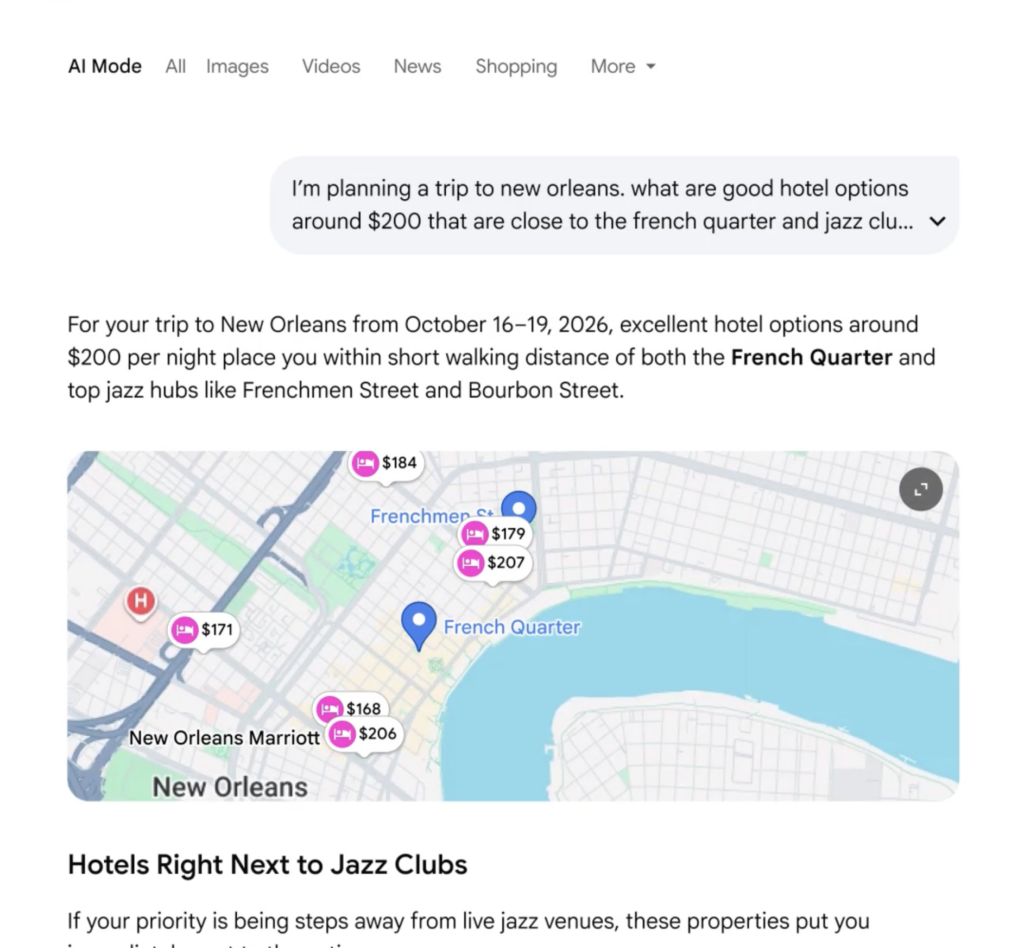
Now, you can describe your trip and preferences, and AI Mode gives you a visual list of hotels with guest reviews and key comparison factors already compiled.
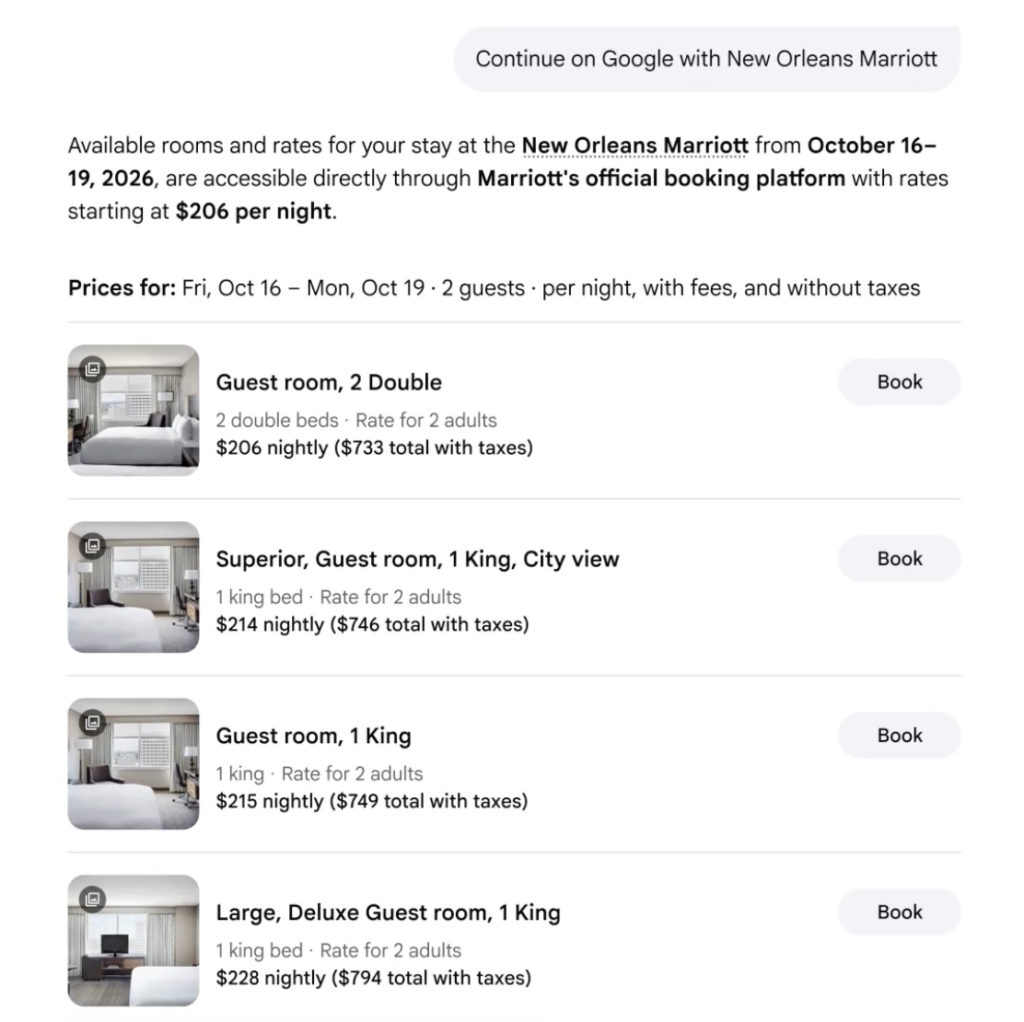
Once you've picked one, you'll see “Continue on Google” next to any integrated partner. A few taps later, you've picked a room, reviewed the cancellation policy, and paid through Google Pay, all without leaving the chat.
How does it work?
The hotel or booking platform remains the merchant of record and handles customer service, so if something goes wrong with your reservation, you're still dealing with a real hotel or booking site on the other end, not Google.
Hotel booking is rolling out in the U.S. in English now, with Booking.com, Choice Hotels, Expedia, Hilton, Hotels.com, IHG, Marriott, Priceline, Trip.com, and Wyndham as launch partners.
Who this can help most:
Those who need specific accommodations or have very specific needs for their stay will be able to find what they're looking for more easily than ever.
I view this as a huge step for those with accessibility needs, and those looking to specifically support small businesses.
You can ask Google's AI mode to specifically sort its recommendations based on the quality of reviews left in the Google Reviews.
Because we know that some hotels or restaurants say they're wheelchair-accessible just so the comment section can disagree.
Or for an establishment to say they're Black-owned, but when you walk in and inquire, they are actually Black-operated. I think this will help us dig through the nuance with a lot more ease, and get answers to what matters to us.
Steal these travel prompt ideas:
- “Find me a Black-owned hotel in New York City that I can stay at for 4 nights in September that's also wheelchair accessible.”
- “Find me a 4-star hotel in Miami's Wynwood neighborhood with a rooftop pool, under $250 a night, for a 3-night stay in November.”
- “Compare these three Marriott properties in Cabo by guest reviews, walkability to the beach, and total price for a 4-night trip.”
- “Find me a locally-owned boutique hotel in Oaxaca with strong reviews for solo female travelers.”
- “Book this Hilton in Chicago for October 9th through 12th, king bed, through Google Pay.”
The Bigger Questions
Given this launch, there are new questions that I can't stop thinking about when it comes to the future of the travel industry. Not because of these three features specifically, but the direction they point in:
The future of travel agents
For example: If AI can track your flight, price your points, and book your room,…what happens to the human being who used to do all three? (i.e. Travel agents.)
Luckily, I don't think travel agents are going anywhere.
A prompt can't replace an agent's 10-year relationship with a hotel manager, niche, firsthand knowledge from hundreds of flights and trips, and their relationship and knowledge of you as a customer!
They know and remember things about you that you may forget about yourself (No, you actually don't want to be so close to the Bad Bunny concert. You're a light sleeper, remember?)
The truth is, many casual travelers don't know what they really want until someone shows them the options. It's truly a skill to know all the things to think of and plan for.
Let alone prompt for.
That's the true value of a travel agent. And the one's who start saying the quiet part out loud: here's what I know that a chatbot doesn't, here's who I know that a chatbot can't call—will thrive.
Smart agents will use this exact technology to scale, not to compete with it.
The future of small business
Here's where it gets interesting for small businesses: if AI Mode can only surface what you tell it, then the businesses that spell out exactly what they offer are the ones who win.
Black-owned. Truly wheelchair accessible, not just ADA-compliant on paper. Locally owned. These shouldn't be details tucked into an About page anymore; they're the whole pitch.
Which means there's a new business opportunity in this. And a really good one, honestly.
Somebody needs to help hotels, tour operators, DMOs, and independent travel agents get “AI-scannable,” the same way an entire industry popped up around getting websites SEO-ready.
Done right, that's not AI replacing small business. That's AI finally listening to the ones who never had the marketing budget to shout.
The Bottom Line
Tracking, redeeming, and booking now live inside one conversation instead of three tabs and three logins. That's the whole shift Google described to us back in April.
My tip if you're about to try any of these: don't just ask for the cheapest option. Ask for what you actually value: accessible, locally owned, Black-owned, close to a grocery store, 5 minutes from the beach, whatever matters to your trip. With AI, we can be very specific now. And it can handle it.
Let AI Mode go find it. A tool that can finally understand a full sentence is a tool that can finally understand what you actually care about.
I'd love to hear your thoughts on Google AI for travelers in the comments of this post.

This was my exact concern, and I asked them this directly. They told us, Google AI pulls live numbers, not estimates, from 300+ partner airlines and travel sites for flights and confirmed data from the airline/hotel partners for points and miles. That's the same trust model Google Flights has used for years. Treat it like any new tool in its first few weeks: double-check your confirmation email the way you always would.
The hotel or booking platform stays the merchant of record and handles customer service, so you're dealing with a real hotel or a real booking site, not Google, if you need to change or cancel something.