After what happened last year, I knew I needed to make getting my Jamaican citizenship a priority.
I'm an American citizen, but I come from immigrants on both sides of my family. Both sides of my family have always loved to travel, too.
Growing up we didn't have a lot of money. But my parents both worked jobs that let them travel occasionally. Sometimes for work, sometimes just because they made it a priority. A road trip most years. A bigger trip once in a while.
That instinct got handed down to me, and now I'm a full-time travel content creator who can hit three or four countries in a single month.
All that movement has had me thinking hard about identity—where I'm actually “from”, where I belong, and what I have a birthright to. Citizenship sits right in the middle of that question.
As a second-generation American, and first-generation college student, I've always tackled things with a sense of proactivity. I opened my laptop and started scouring articles, TikTok videos, Reddit threads, and more to see how difficult it was to get my Jamaican citizenship by descent.
And I did it. Below is the YouTube video chronicling my emotional and mental journey getting my dual citizenship. How long it took, what happened day to day, etc.
This article is for the technicalities, all the things that would take too long to put in the YouTube video, I'm dropping here to make sure I fact-check everything, attach links, and don't get anything wrong.
But first, a storytime, and cautionary tale…
Storytime: How me and thousands of others almost got Italian citizenship—but didn't.
A few years ago, Italian citizenship by descent was everywhere on my FYP. Anyone with even a sliver of Italian ancestry was chasing it, because of what it opened up. You'd see viral headlines about buying an abandoned Italian house for $1, or getting an Italian digital nomad visa- that whole genre of content.
I have Italian roots through my mom, so I told myself I'd apply. I said that for two or three years.
Then I went to Italy. I found a long-lost cousin there. Every sign pointed toward applying. Becoming an Italian citizen felt like something I was already halfway toward. I just had to do the paperwork!
Right around the time I turned 30 and finally got the itch to actually do it… Italy changed its laws.
Almost overnight, the standards got stricter. And the window I thought I had closed before I ever walked through it.
That stung. But it also taught me something I couldn't unlearn:
The ‘someday' version of citizenship doesn't exist. Laws don't wait for us to get around to them. The window you're putting off can close before get a chance to walk through it.
As of now, Auust 2026, I've heard Italy has walked back parts of that stricter law. Maybe that window reopens for me eventually. As of right now, though, I'm still not eligible.
So when the Italy window shut, I looked at what was still open.
Enter, Jamaica.
My dad was born in Jamaica. I have direct lineage through him, and I'm so proud of that side of my heritage. Getting my Jamaican passport felt like a real first step into knowing more of it.
I live in New York City, home to one of the largest Jamaican consulates outside the island.
I immediately opened my laptop and started researching.
For anyone else who's second-gen and has been sitting on this exact idea, here's everything I did, everything it cost, and everything I wish I'd known going in.
What you actually need to qualify for citizenship-by-descent
Every country has different requirements.
I can't emphasize that enough. In some, it's based on your parents' citizenship at birth (like Jamaica). In some, it can be based on the birth citizenship of your grandparents, or even great-great-grandparents (like Ireland, Spain, and Portugal). Some can only be done through your father's side (like Lebanon, Kuwait, and Qatar).
Every country is a mixed bag, so you've got to do your individual research!
Some you can't apply to if
Jamaican citizenship by descent applies to anyone born outside Jamaica to a parent—mother or father, or both—who was a Jamaican citizen at the time of that person's birth. If you're going through a grandparent or great-grandparent instead of a parent, you can still qualify, but the document trail gets longer.
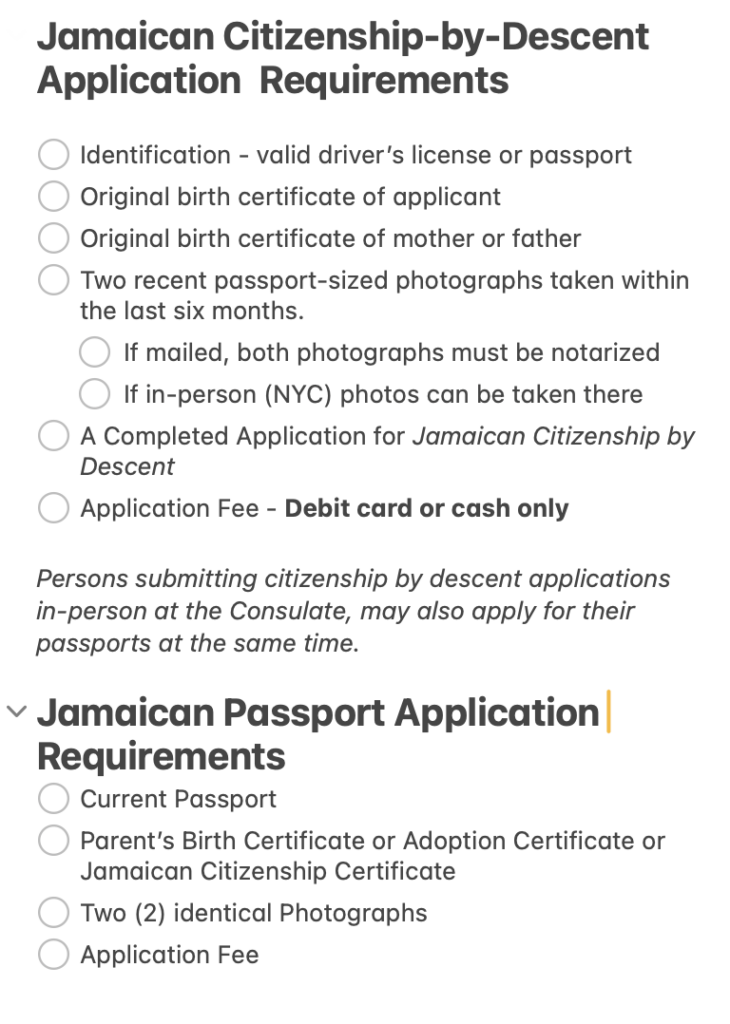
According to the Consulate General of Jamaica in New York, here's what you're expected to bring:
- A completed Application for Jamaican Citizenship by Descent form
- Your original birth certificate
- Your Jamaican parent's original birth certificate
- If applying through a grandparent or great-grandparent, their original birth certificate too
- Your original marriage certificate, if applicable
- Your parents' original marriage certificate, if you were born in wedlock
- An original deed poll or naturalization certificate, if a parent or grandparent legally changed their name
- A valid government-issued ID for your Jamaican parent (driver's license or passport)
- Your own valid government-issued ID (driver's license or passport, for adult applicants)
- Two recent passport-sized photos, taken within the last six months
Three details that trip people up:
- Your father's name has to actually appear on your birth certificate if you're claiming through him
- The spelling of names has to match exactly across every document
- And any errors on your paperwork need to be fixed at the source before you submit—not after. Fix a typo on your birth certificate now, not while a consular officer is holding your file!
Where to go to apply: The 3 Options
You've got three routes, and where you live decides which makes sense:
- A Jamaican consulate or high commission near you, if you live outside Jamaica. The Jamaican Embassy in Washington D.C. Consulate General of Jamaica in New York serves the tri-state area. And there are additional missions in cities like Miami and Atlanta, plus high commissions in Canada and the UK.
- If you're in Jamaicam the Passport, Immigration and Citizenship Agency (PICA) can take your application directly
- By mail, from wherever you are, sent to your nearest consulate or to PICA.
I live in New York City, so I went with Option 1: going in person to the Jamaican Consulate.
I went to the consulate's site, found the citizenship appointment form, and booked a slot for that same week as they had a lot of availability!
Should you apply for citizenship by descent in person, or by mail?
One warning from my research: don't send in by mail. Just don't.
Mailed applications have to jump through an extra hoop: your two photographs need to be notarized, with the notary writing out “I certify this to be a true photo of [your full name],” then signing, stamping, and dating it.
You also need to include a prepaid, self-addressed envelope (FedEx, UPS, or USPS express or certified mail) so the consulate can mail your original documents back to you. And sending original birth certificates and funds via mail? I would never.
Going in person skips the notarization step entirely, and there's one more reason it's worth the trip if you can manage it: you can apply for your citizenship certificate and your passport in the same appointment. Which is exactly what let me start both processes in one trip instead of two.
If you're near a consulate, go in person.
If you're not, mail is technically workable… just budget the extra notary step, mailing costs, and some extra time into your plan.
How much does it cost to apply for Jamaican citizenship-by-descent as an American?
The official citizenship application fee, per the NY consulate, depends on your history:
- $40 if you currently have, or have ever had, a Jamaican passport (even expired) — this covers courier and consular processing only.
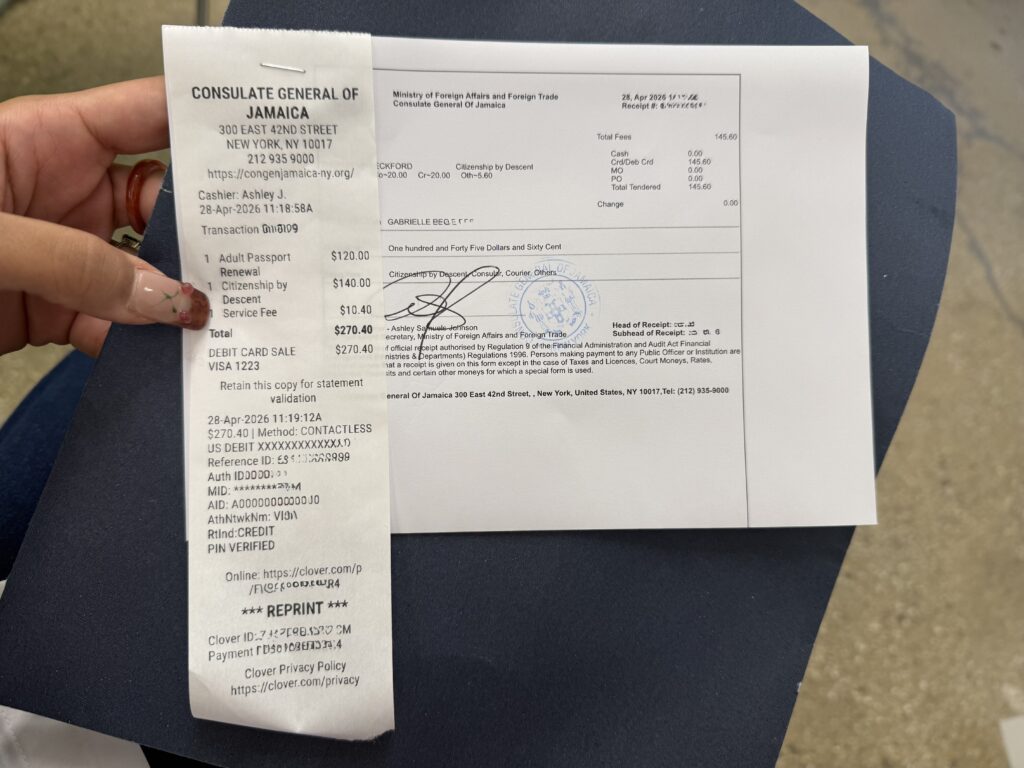
- $140 if you've never held a Jamaican passport. This already includes that $40 courier and consular fee, payable by money order, cash, or credit/debit card.
If you're also applying for your Jamaican passport at the same appointment (which I'd recommend), add roughly $80 for a standard adult passport application, per the consulate's fee schedule.
That baseline lands most first-time applicants around $220 in official fees. The gap between that and the roughly $300 I actually spent came from the parts nobody puts in the FAQ: notarizing documents, extra passport-style photos, printing and copying, and getting myself to and from the consulate in Manhattan.
Those add-ons are the real cost of doing the thing, quietly stacked on top of the quoted fee.
Budget $300–$400 all in.
How long does it take to get your Jamaican passport?
This is the part that requires patience. Once your application is complete and gets transmitted from the consulate to PICA in Jamaica, official processing takes 90 business days, plus transit time for your documents to travel between the consulate and the island.
That's roughly four to five months from a fully compliant application to a certificate of citizenship in hand, not counting whatever time it takes you to gather documents beforehand.
My actual appointment: the wait in the consulate, the review of my paperwork, the submission — took about 30 minutes.
Much faster than I thought!
The 5 hours I mentioned was everything around it: pulling records, making copies, getting to the consulate and back, filling out forms correctly the first time so nothing bounced back to me.
The appointment itself was fast. Getting ready for the appointment was the actual work, but I went at 11 AM on a weekday.
Time needed: 14 days.
A quick, no-frills breakdown of exactly how to apply for your Jamaican citizenship-by-descent at the New York Consulate of Jamaica. Bookmark this article if you're actually about to start your own application!
- Gather your documents.
Read the article again for specifics. Pull these together before you book anything — replacement certificates and corrected paperwork take time you don't want to burn after your appointment is already on the calendar.
- Decide how you want to submit your application.
The Consulate General of Jamaica in New York handles the tri-state area and requires appointments for every service, including citizenship. Book for citizenship specifically, not passport or another service, since showing up for the wrong appointment type means you won't be seen.
- Go to your appointment and arrive 15 minutes early.
Dress appropriately. And bring cash. Double-check your passport photos meet Jamaican specs before you go, since American-sized photos will likely get rejected on the spot.
- Go through the process.
They'll ask you questions based on how you filled out the form. For me, applying through citizenship by descent meant knowing my grandparents' full names, their birthdates, and where my dad was born, plus a few facts like that. Then you pay, and you're done for the day.
- Wait!
The consulate will eventually call or email you, so check both. My call came about four months after I applied, from a New York 212 number—don't let it go to spam, and if it does, call them back – (212) 935-9000. It might take a few tries to get through, but you will.
Why apply? Some real benefits of Jamaican citizenship
I'm saving the personal, emotional “why I want this” for its own post — that's a different story.
But the practical rights that come with Jamaican citizenship are worth knowing on their own terms, separate from any individual reason for wanting them.
Jamaica has allowed dual citizenship since a 2002 constitutional amendment, per PICA's official dual citizenship guidance — becoming a Jamaican citizen does not require giving up the citizenship you already hold, and vice versa, though you should always double check the rules of your other country of citizenship too. Once you're a citizen:
- You have an unconditional right of abode. You cannot be deported from Jamaica, and you can live and work there without a visa or work permit, for as long as you want. No need for a digital nomad visa anymore (though they're still amazing) – I'll have resident rights!
- You're entitled to consular assistance from any Jamaican embassy or consulate worldwide if you run into trouble while traveling.
- You can vote and hold property under the same terms as any other Jamaican citizen.
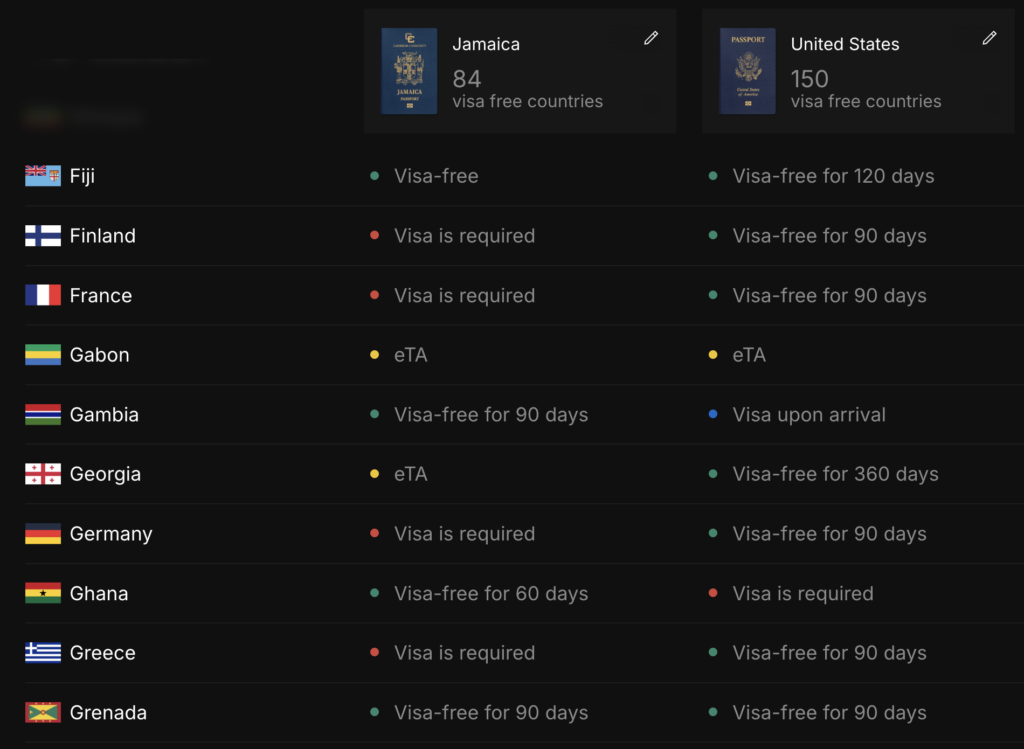
- You carry a Jamaican passport, which as of 2026 grants visa-free or visa-on-arrival access to over 100 destinations across much of the Caribbean, the Americas, and Africa. It's a different set of doors than a U.S. passport opens, and an especially useful one for someone who travels as often as I do, per passport ranking data.
One thing worth knowing going in: Jamaican law is clear that once you take on a second citizenship, you're subject to the full responsibilities of that citizenship too, with each country's rules applying fully and simultaneously. Dual citizenship comes with dual obligations right alongside the dual benefits.
How hard is the process, really?
Here's the honest answer, from someone who just lived it: paperwork involving any government is annoying by default, and this one is no exception. But it was way less complicated than I expected walking in.
The hardest part was the version of this project that lived in my head for years. The one where I assumed dual citizenship was some multi-year legal odyssey reserved for people with immigration lawyers on retainer. That imagined version kept me from starting.
The real version took a weekend of gathering documents, one 30-minute appointment, and a five-month wait I now get to spend doing other things.
I felt every emotion in that consulate waiting room.
I felt frustrated filling out yet another form with my father's name spelled three slightly different ways across three different documents. I felt something close to grief, thinking about the Italian window that shut on me before I ever got to open it.
And by the time I walked out, I felt proud.
Genuinely, uncomplicatedly proud that I'd stopped letting “someday” run the show and just did the thing.
I don't know yet what this actually changes for me— what doors a Jamaican passport opens beyond the ones my U.S. passport already does. What it means to formally claim a piece of my identity I've always felt but never had documented.
I'll write about all of that separately, once the actual passport is in hand!
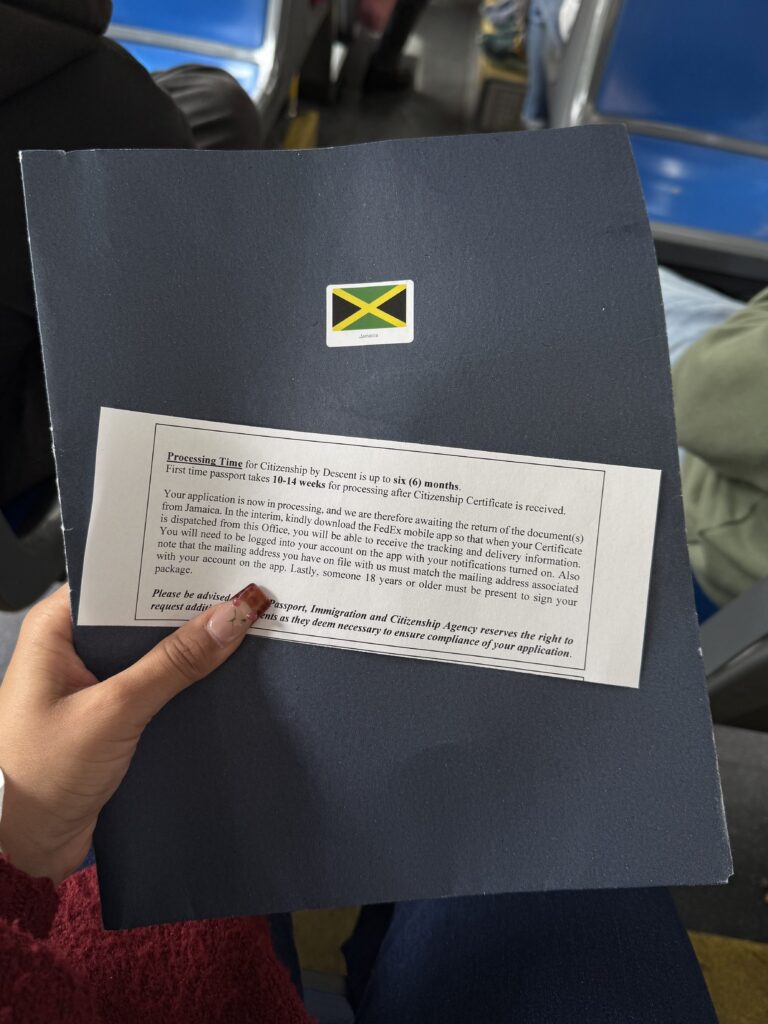
If you're Jamaican-American and you've been sitting on this: start today
You don't need to have it all figured out before you start. You need three things: proof of your qualifying parent's citizenship, your own identity documents, and an appointment.
- Google the specific requirements for your ancestry country. Descent rules vary enormously by country, and Jamaica's process won't look like Italy's or Nigeria's or the Philippines'.
- Find your nearest consulate or high commission, and check whether they take walk-ins or require appointments (most now require appointments).
- Start pulling your documents this week, not the week of your appointment. Birth certificates and marriage certificates take time to request if you don't already have copies on hand.
- Go in person if possible. It's faster, it skips the notary requirement, skips the anxiety of mailing your original birth documents (!), and you may be able to knock out your passport application in the same visit like I did.
I almost let a closing window make the decision for me once already. I'm not doing that again.
If any part of this has been sitting in your Notes app as a someday-project, today is a fine day to Google the requirements and see how close “someday” actually is.
Official fees run $40–$140 for the citizenship certificate depending on whether you've held a Jamaican passport before, plus roughly $80 for the passport itself, per the NY consulate's fee schedule. Realistically, budget $300–$350 once you factor in notary fees, extra photos, and incidentals.
Yes. Jamaica has allowed dual citizenship since a 2002 constitutional amendment, so becoming a Jamaican citizen doesn't require giving up your U.S. citizenship, and the reverse holds too.
No! Your U.S. citizenship itself isn't affected. Your tax obligations don't change either. The U.S. taxes citizens on worldwide income no matter where they live or which other passport they hold, so you'll still file a U.S. return every year (though tools like the Foreign Earned Income Exclusion and Foreign Tax Credit can offset double taxation if you start earning income in Jamaica—I used this credit when I was a full-time digial nomad 2021-2024, and it's a life saver)
No. Not unless you actively choose to give up your U.S. citizenship later, which is a separate, irreversible process.
Applying for both at the same in-person appointment, like I did, lets them move through the system together instead of one waiting on the other. If you apply by mail or apply for citizenship first, expect the passport step to add its own processing time on top of the roughly 90-business-day citizenship wait.
You can request a certified replacement directly from Jamaica's Registrar General's Department, either online if you have the birth entry number or through a Jamaican consulate. Processing times run anywhere from about a week to six weeks depending on the service tier, so it's worth starting this before you book your citizenship appointment!
The consulate wants an original marriage certificate if the name change came from marriage, or a deed poll or naturalization certificate if it came from a legal name change. The same rule that applies if your parent or grandparent changed their name. Bring documentation connecting every name you or your parent has legally used, since a mismatch is one of the most common causes of delay.
Yes. Minors can apply for Jamaican citizenship by descent too, with a Jamaican parent's government-issued ID and the standard birth certificate documentation submitted on the child's behalf. Fees and processing generally follow the same structure as an adult application.
Three things I wish I'd known: Jamaican passport photo specs are different from standard American ones, and mine got rejected on the spot, costing an extra $30 to retake them right there in the office. They technically take cards, but the appointment notice specifically calls for cash, so bring cash as your main plan and a card or Apple Pay as backup. And dress business casual: shoulders and knees covered, no low-cut tops, no flip-flops. The consulate does enforce it.
No. Jamaican citizenship by descent is pretty straightforward with the right documentation, luckily. But some other countries—like European countries including Spain, Britain, and Italy—can be a much lengthier process and legal support is common. They even have entire agencies dedicated to citizenship by descent and general immigration!